Evidence before precision
Unknowns remain visible instead of becoming confident-looking estimates.
Fictional enterprise scenario · Reviewable method · No customer data
Follow one private-RAG opportunity through discovery, first-pass sizing, architecture framing, financial review, and a conditional executive recommendation.
Unknowns remain visible instead of becoming confident-looking estimates.
Early sizing exposes sensitivities and bottlenecks; it does not impersonate a benchmark.
Architecture, security, benchmark, pricing, and finance reviews remain human decisions.
Interactive decision path
Use the stage controls or left and right arrow keys to move through the opportunity.
Stage 1 · Opportunity discovery
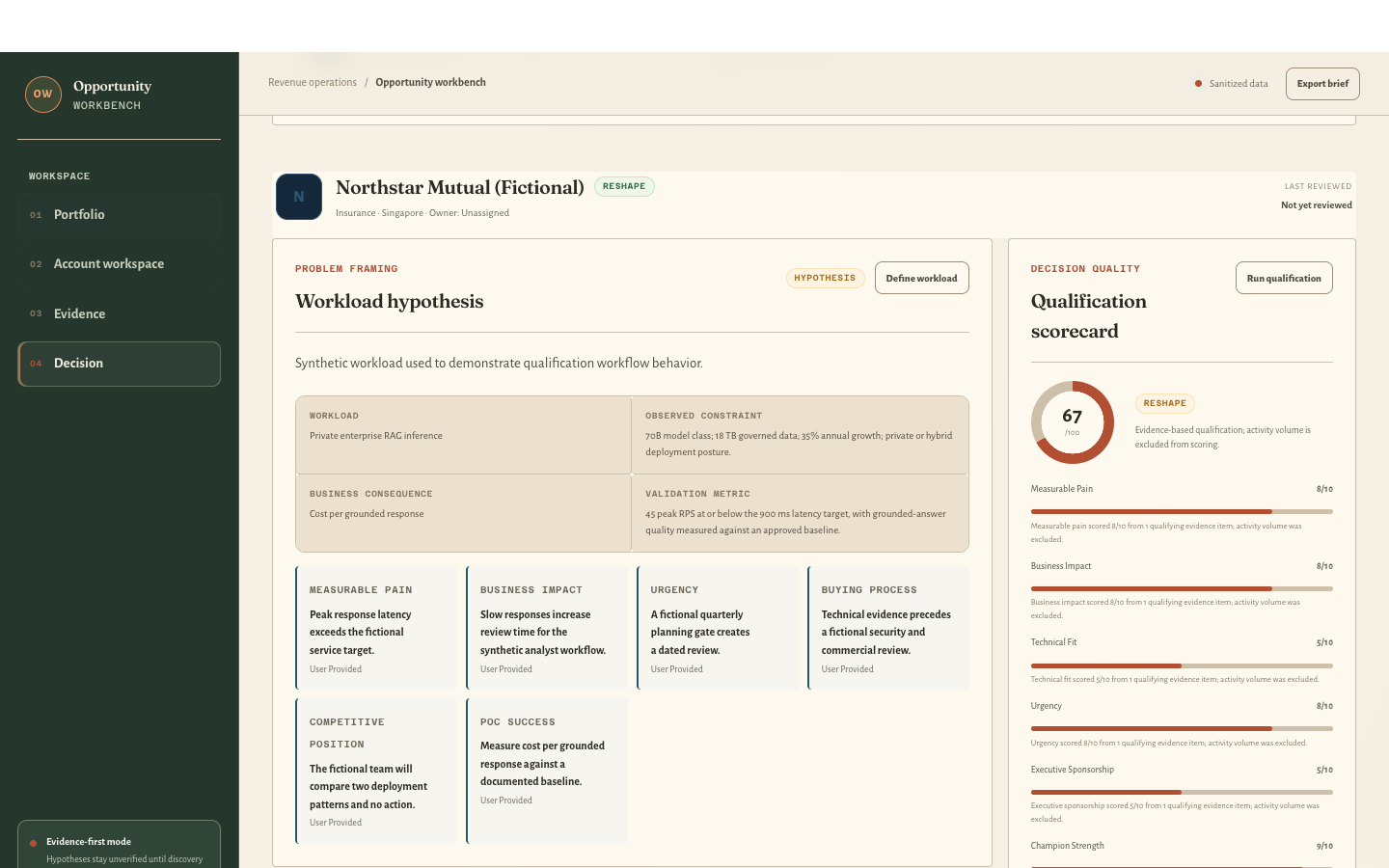
The discovery record separates the stated workload and control requirements from assumptions that still need customer evidence.
Private RAG over governed internal content with a stated peak and latency objective.
Token distribution, concurrency shape, quality threshold, retrieval design, baseline cost, and support model.
Premature architecture or pricing precision would conceal the evidence gap rather than reduce it.
Workload hypothesis, stakeholder map, evidence gaps, and conditional next action.
Named sponsor, representative workload owner, and agreement to a validation-planning workshop.
Executive handoff
The use case is specific enough to justify a controlled PoC, but final infrastructure and commercial decisions remain gated by representative workload data, benchmark results, security review, operating-model ownership, and current pricing.
What this walkthrough proves
Separate sourced facts, assumptions, missing evidence, stakeholders, and next actions.
Reason across model fit, throughput, latency, memory, storage, network, power, reliability, and operations.
Present a hypothesis with alternatives, risks, validation requirements, and approval boundaries.
Normalize operating states, preserve assumption lineage, stress the case, and distinguish modeled value from realized savings.